
The TikTok Tom Cruise everyone fell for
You’re scrolling through TikTok when Tom Cruise pops up. He’s playing golf, pulling off a magic trick, joking around as if he were letting you into his everyday life. He looks like Tom Cruise, sounds like Tom Cruise, and even laughs like him. For a fan, it feels like a backstage pass. Except it isn’t Tom Cruise.
In 2021, the account @deeptomcruise went viral with a series of extremely realistic videos. Behind the screen were Belgian visual-effects artist Chris Umé and Miles Fisher, an actor who impersonates Cruise. Fisher performed the scenes, Umé digitally swapped in Cruise’s face, and viewers started debating whether the real actor had joined TikTok.
Back then, pulling this off took serious skill and effort. Today, AI tools can generate or alter faces, voices and videos with far less expertise. Which brings us to a bigger question: what happens when we can’t trust everything we see and hear?
So, what exactly is a deepfake?
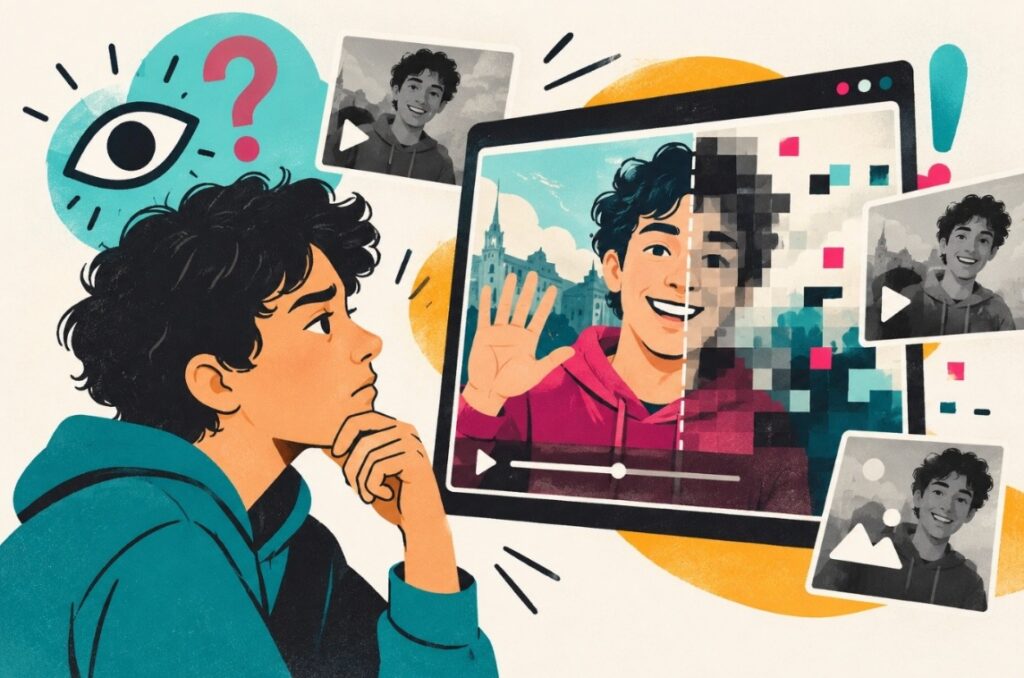
A deepfake is media created or manipulated with AI to make someone appear to say or do something they never said or did. It doesn’t have to be built from scratch: AI can tweak just one piece of something that already exists.
- A face: one person’s face placed on another person’s body
- A voice: a cloned voice saying new words
- A video: generated or changed speech, expressions or movements
Be careful though: not every AI-generated image or video is a deepfake. The term is mainly used when AI imitates a real person in a way that could mislead viewers or listeners about what they actually said or did.
As with many AI systems, data is the fuel that makes a convincing deepfake possible. The more images and recordings an AI can learn from, showing different angles, lighting conditions and facial expressions, the more accurately it can reproduce someone’s face and movements. This makes celebrities, politicians and other public figures particularly easy to imitate, as countless photos and videos of them are publicly available. And as the tools become easier to use, creating convincing fakes becomes easier too.
From funny clip to fake news and vishing
But here is where it gets uncomfortable. The technology behind an amusing celebrity video can just as easily make a politician announce a decision they never made, or show someone at an event that never happened. Once shared, it can reach thousands of people before anyone checks.
And repetition makes it worse. A 2024 study across eight countries looked at viral deepfakes and the illusory truth effect: the more we see something, the more familiar it feels, and familiar starts to feel true, even when it isn’t. A deepfake doesn’t need to fool you the first time, it just needs to keep showing up in your feed.
And sometimes it doesn’t show up in your feed at all. Sometimes it calls you.
Your phone rings. It’s your child, frightened, saying there’s been an accident and they urgently need money. The voice is exactly theirs. Except it isn’t them.
With voice cloning, AI can reproduce someone’s voice from recordings, allowing scammers to impersonate people we trust (vishing). You don’t have to be “bad with technology” to fall for it. When someone that close to us sounds scared, our instinct is to believe them and help before we have time to question what’s happening.
This isn’t a distant, futuristic threat. It’s already happening, and none of us is immune.
The deeper problem: doubting everything
Now if anything can be fake, what happens to the real content?
Picture an authentic recording of a public figure saying something controversial. They shrug and say: “That wasn’t me. It was AI.” This is called the liar’s dividend: once convincing fakes exist, anyone can use that doubt to dismiss genuine evidence.
So deepfakes don’t just make it harder to spot what is false, they can make it harder to believe what is true…
So how can we protect ourselves?
The good news is that you don’t need to become a deepfake detective. Strange hands, unnatural movements and robotic voices will become less reliable clues as the technology improves. What lasts is a habit of verification:
When something makes us feel surprised, angry, scared or excited, it is worth taking a moment before reacting or sharing it. Where does this information come from? Who posted it? Is there an original source? Checking whether another reliable source confirms it can also make all the difference. The same goes for messages and calls from people we know: if someone suddenly asks for money or sensitive information, especially in a rush, take a step back and contact them through another channel before acting.
That’s also why education matters. Schools can’t just teach today’s tricks, because the tricks keep changing. What lasts is learning to question sources, check evidence, compare information and spot emotional manipulation. A great question to practise is: “What makes me believe this, and how could I check?”
Seeing isn’t enough anymore
For a long time, seeing or hearing something ourselves was our strongest proof. AI is shaking that up. That doesn’t mean we should distrust everything. It means trust can’t rest on a single piece of evidence anymore. We need to look at where information comes from, what surrounds it and whether it can be confirmed.
Digital literacy is no longer just knowing how to use technology. It’s understanding how technology shapes what we see, what we believe and what we decide.
So the next time something looks too real, too shocking or too perfect, ask the question that matters most: “How do I know?”
References
Ahmed, S., Bee, A. W. T., Ng, S. W. T., & Masood, M. (2024). Social media news use amplifies the illusory truth effects of viral deepfakes: A cross-national study of eight countries. Journal of Broadcasting & Electronic Media, 68(5), 778–805. https://doi.org/10.1080/08838151.2024.2410783
Chesney, R., & Citron, D. K. (2019). Deep fakes: A looming challenge for privacy, democracy, and national security. California Law Review, 107(6), 1753–1820. https://doi.org/10.15779/Z38RV0D15J
European Commission. (2026, July 24). Transparency obligations under Article 50 of the AI Act. https://digital-strategy.ec.europa.eu/en/faqs/transparency-obligations-under-article-50-ai-act
Hern, A. (2021, March 5). ‘I don’t want to upset people’: Tom Cruise deepfake creator speaks out. The Guardian. https://www.theguardian.com/technology/2021/mar/05/how-started-tom-cruise-deepfake-tiktok-videosiris.unimo
Ireton, C., & Posetti, J. (Eds.). (2018). Journalism, “fake news” & disinformation: Handbook for journalism education and training. UNESCO. https://unesdoc.unesco.org/ark:/48223/pf0000265552
Metz, R. (2021, August 6). How a deepfake Tom Cruise on TikTok turned into a very real AI company. CNN. https://www.cnn.com/2021/08/06/tech/tom-cruise-deepfake-tiktok-company
Naffi, N. (2025, October 1). Deepfakes and the crisis of knowing. UNESCO. https://www.unesco.org/en/articles/deepfakes-and-crisis-knowing