
Artificial intelligence no longer asks if it can come to school. It’s already here – on students’ phones, on teachers’ computers, on assignment-creation platforms, and in everyday conversations about learning. Some see it as an opportunity to personalize education, while others fear that technology will become a way to avoid putting in the effort. However, the most important question today is not “Should we use AI?” but “How can we use it in a way that keeps people at the center?”
School has always been a place where we learn not only answers but also how to ask questions. Therefore, the emergence of generative AI is not merely a technological change. It is a call to reexamine the very meaning of learning.
Not a Faster Answer, but a Better Question
In the past, when a student was given an assignment, they first had to think. Today, a new intermediary has emerged between the assignment and the answer – artificial intelligence.
This isn’t necessarily a bad thing. The problem arises when AI becomes the first step rather than a tool. If a student hasn’t yet formulated their own thoughts, tried to remember, made a mistake, or sought a solution, but instead immediately asked AI to do everything for them, the learning process becomes shorter, but not necessarily more meaningful.
Therefore, in the next-generation school, an important skill is not just knowing how to use AI tools. Even more important is knowing when not to use them.
A student should be able to ask themselves: What do I already know? What can I do on my own? Where exactly do I need help? Is the answer provided by AI correct? What can I learn from it?
This also changes the teacher’s role. The teacher is no longer merely a source of knowledge. The teacher becomes someone who helps students distinguish between assistance and dependence, information and understanding, and convenience and real learning.
AI Can be a Mirror, but not the Student’s Mind
One of the most interesting possibilities of AI is its ability to show students the gaps in their own thinking.
A student can ask the AI not to write an essay, but to provide questions that help improve the student’s own text. In a math class, the AI can, instead of solving a problem, point out where a mistake was made. In language learning, it can serve as a conversation partner, allowing students to practice the language as many times as needed in a safe environment.
This is one of the most important capabilities of AI: the technology can provide students with more opportunities to practice.
A teacher cannot physically be with every student every second. AI can offer an additional explanation, a different example, or a hint. However, the final word should come from a human.
The effective use of AI is like scaffolding on a construction site. It helps build a taller structure, but it isn’t the structure itself. Once a student can complete a task independently, the scaffolding is no longer needed.
Therefore, the question shouldn’t be “Did the student use AI?” but rather “What did the student do on their own while using AI?”
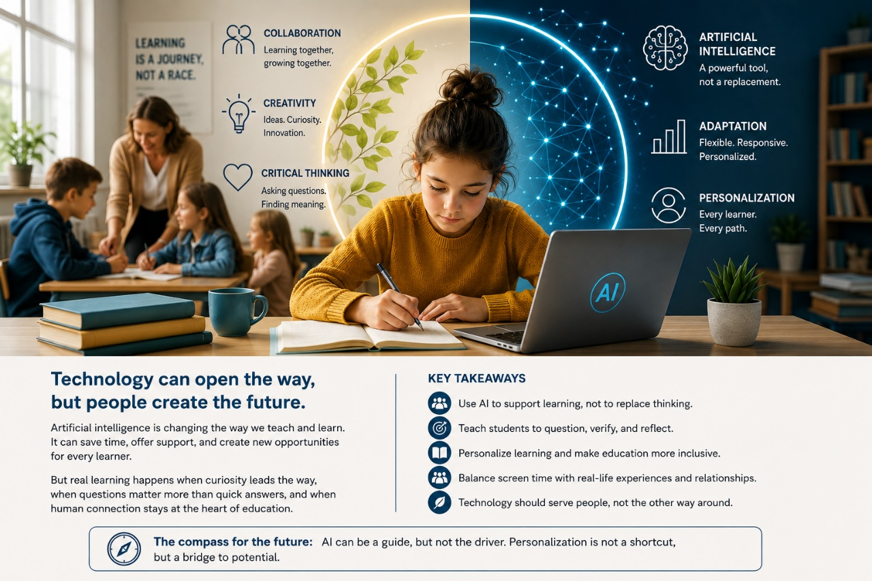
Conceptual visual created by artificial intelligence.
Personalization Is Not a Luxury, but an Opportunity
One of the greatest advantages of artificial intelligence in schools is the ability to respond more easily to the diversity of students.
In the same classroom, one student will understand an assignment in a few minutes, another will need additional explanation, a third will need a visual example, and a fourth will need more time. The teacher must notice all of this and address it simultaneously.
AI can help facilitate this process. It can offer tasks of varying difficulty, rephrase text in simpler language, provide additional examples, or help the teacher prepare several versions of the same task.
This is particularly important in inclusive education. If a student has difficulty reading a long text but understands its content perfectly well when listening to it, converting the text to audio is not a “cheaper way out.” It is an opportunity to achieve the same learning goal in a different way.
This is precisely where AI and digital technologies align with the concept of Universal Design for Learning: not forcing all students to learn in the same way, but enabling everyone to achieve the learning objective through different paths.
Critical Thinking is Becoming More Important than Ever
AI can write a convincing text, present arguments, and create a realistic picture or an answer that sounds confident but is actually incorrect.
Therefore, critical thinking in school is no longer just an additional skill but one of the core competencies of the digital age.
Students must learn not only how to obtain information, but also how to verify it.
Who created this content? What sources are cited? Is the fact verifiable? Is the answer logical? Is there any bias?
This is a new level of literacy – AI literacy. Its essence remains very human: the ability to question, verify, compare, reason, and take responsibility for one’s own decisions.
The More Technology There is, the More Important the Human Factor Becomes
The more AI appears in the classroom, the more evident it becomes what technology cannot replace.
AI can provide feedback, but it cannot get to know a student the way a teacher does. It can generate a question, but it doesn’t sense the mood of the class. It can offer a motivational text, but it doesn’t notice that one glance that says: “I don’t believe I can do this today.”
Learning is not just about processing information. It’s about relationships, trust, encouragement, accepting mistakes, and the experience of knowing that someone believes in your potential.
That’s why, the more AI enters the school, the more important it is to preserve live conversation, collaboration, creativity, movement, and screen-free time.
Paradoxically, in the age of artificial intelligence, schools may need even more humanity, not less.
Schools shouldn’t be afraid of AI. They must learn to use it.
Perhaps it’s not worth asking whether AI will replace teachers. A much more important question is: what kind of teachers will AI help us become?
Teachers who spend more time correcting repetitive tasks? Or teachers who can devote more time to conversations with students?
One that creates the same assignments for the entire class? Or one that can more easily offer different assignments to different students?
The school of the future doesn’t have to choose between people and technology. It needs to learn how to combine the two.
Artificial intelligence can be an excellent assistant, a creative partner, a tool for personalized learning, or a way to make a teacher’s job easier. However, it should not become the one who thinks for the student or makes decisions for the teacher.
Technology can open doors. It can show more paths. It can help us climb higher.
But it is the person themselves who must step through the door.
Perhaps this is precisely one of the most important missions of a teacher – not only to teach children how to use artificial intelligence, but to help them understand how to remain thinking, creative, responsible, and curious people in a world where machines can do more and more things.
Because in innovative educational space, the most important question will not be what artificial intelligence can do.
The most important question will be: with the help of artificial intelligence, what does a person still want to and is still able to create on their own?