Featured image: AI-generated image. Link to the cited article: https://www.reuters.com/technology/norway-imposes-near-ban-ai-elementary-school-2026-06-19/
The news invites an easy headline: “Norway imposes a near-ban on AI in elementary schools”.
But that would be incomplete. This is not a war on technology. It is an attempt to distinguish among ages, cognitive tasks, the responsibilities of teachers and the needs of students. And for that reason, it raises a useful question for other European countries: when does caution protect learning, and when does fear begin to diminish it?
Those concerns about AI may be justified. A conversational AI can produce prose that is polished and wrong. It can become a shortcut around intellectual effort. It can unsettle traditional methods of assessment, expose personal data and reproduce biases embedded in training data. It would be naïve to think that placing a chatbot in a classroom is enough to improve education.
But it is equally naïve to think that the problem can be solved by banishing AI from the educational horizon. Artificial intelligence is not waiting for a school board vote. It is already present in search engines, writing platforms, social networks and the apps students use beyond the school gates.
A ban can define a boundary. It cannot erase a cultural environment.
But the alternative to a ban is not blind trust. That is where the more important question begins. Schools should not ask only whether AI helps or harms. They should ask: which parts of the work do we want students to continue doing for themselves?
That distinction is less dramatic than a prohibition, but more serious. Drafting a first paragraph, forming a hypothesis, working through a difficult problem, comparing sources, spotting an error and defending an argument aloud are not the same kind of act. In some of them, AI can remove the very effort through which learning occurs.
The concern is straightforward: a generative system can improve the visible result of an assignment without guaranteeing that the student who submits it has learned more. A teenager may turn in a more elegant essay and still be unable to make an argument once the support disappears. That is the danger of cognitive outsourcing: using a tool not to think better, but to avoid thinking at all.
It does not follow, however, that AI is incompatible with school. It follows that AI cannot replace teaching.
Used with a clear educational purpose, AI can become an object of analysis or a tool for inclusion. Imagine a history lesson. Rather than asking students to generate a finished report, a teacher might ask an AI system to produce a deliberately incomplete account of an event, then challenge the class to identify what has been omitted, oversimplified or causally misunderstood. In a literature class, AI might offer three interpretations of a poem. The task would not be to choose the “best” one, but to test which interpretations the text can actually support.
These are not shortcuts. Properly designed, they shift the center of gravity from the finished product to the exercise of judgment.
Concerns about AI can lead to two limiting mistakes. The first is to treat every use as suspicious: did this student write the essay, or did a machine? The second is to assume that authentic learning requires students to be cut off from the tools that exist beyond the classroom.
But genuine learning is not the same as isolation from the outside world. It is the ability to account for what one knows, the choices one makes, the sources one uses and the limits one recognizes. In this specific case, students need to distinguish between AI as a substitute for thought and AI as an object of thought.
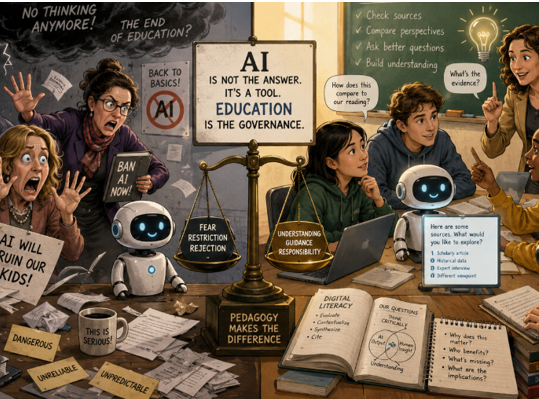
It would be reductive, then, to stop at the newspaper headline. Norway’s approach to AI in schools is more interesting than a simple ban. It recognizes that artificial intelligence is not a technological fate. It is a pedagogical question to be governed.
Protecting younger children from premature shortcuts makes sense. Reading, writing, calculating, listening and sustaining attention remain foundational skills. But growing up also means encountering complex tools under guided conditions and learning to use them without becoming dependent on them.
The real digital illiteracy of the future will not consist only in not knowing how to use AI. It will consist in knowing when to question it, when to rely on it and when to think independently. That is where schools have a crucial role to play: not simply giving students access to new tools, but teaching them how to judge their use.