
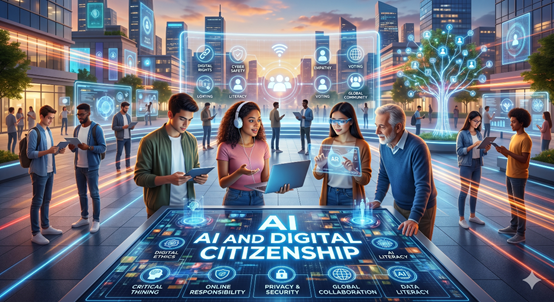
Featured Image: Ai generated image
Digital citizenship refers to the responsible, ethical, and informed participation of people in digital environments. It includes the ability to communicate respectfully online, protect personal data, evaluate information critically, understand digital rights and responsibilities, and use technology in ways that are safe and meaningful.
With the rapid development of artificial intelligence, digital citizenship has become even more important. AI tools are now used in search engines, social media platforms, learning applications, translation tools, image generators, chatbots, and many other everyday technologies. These tools can support creativity, learning, productivity, and communication. However, they also create new challenges.
Secondary education is a crucial stage for developing digital citizenship and AI literacy. Students at this age use digital technologies daily for communication, entertainment, learning, and social interaction. They are also increasingly exposed to AI tools, often without fully understanding how these tools work or what risks they may involve.
Introducing AI and digital citizenship in secondary education helps students develop critical thinking from an early age. They learn to question online information, recognize misinformation, understand algorithmic influence, and reflect on the ethical use of technology. These skills are essential not only for school but also for future studies, employment, and participation in society.
AI education in secondary schools should not be limited to technical knowledge or programming. Students also need to discuss real-life questions: Can AI be biased? Should students use AI for homework? How can we protect personal data? What happens when AI creates fake images or deepfakes? Who is responsible when technology causes harm?
Schools should approach AI and digital citizenship in a practical and balanced way. The goal should not be to create fear around AI, but to help students use it responsibly and critically. Some specific goals should be:
- Students should be taught to verify AI-generated information. They need to understand that AI tools can produce answers that sound correct but may contain errors.
- Students should learn about privacy. They should avoid entering personal data, private conversations, school records, or sensitive information into AI tools.
- Schools should promote transparency. When students use AI to support their work, they should explain how they used it.
- Teachers should include ethical discussions. Students can examine examples of AI bias, deepfakes, misinformation, and automated decision-making.
- AI should be used as a learning assistant, not as a replacement for thinking. Students can use AI to ask questions, receive explanations, practice writing, or explore different viewpoints.
- Teachers need support and training. Educators should be given clear guidelines, examples of classroom activities, and opportunities to experiment with AI tools themselves.
AI is already part of students’ digital lives. Secondary education has the responsibility to help them understand it, question it, and use it wisely. Teaching AI through the lens of digital citizenship can help young people become more informed, ethical, and active participants in the digital world.